

Aluminum Alloy Antistatic Floor Solutions for Superior Static Control
2026-09-07
Most floors are just surfaces. But in spaces where a stray static charge can corrupt data, destroy components, or even trigger fires, flooring becomes a first line of defense. That's where aluminum alloy antistatic solutions from Lipin Floor come in. Built for superior static control, they don't just cover the floor—they help protect everything above it.
What Makes Aluminum Alloy a Natural Conductor
At the atomic level, aluminum atoms readily shed their three outer electrons into a shared "sea" that drifts under an applied voltage. This metallic bonding is unusually generous compared to many other metals, because the energy required to move these electrons is relatively low. Even when alloying elements such as magnesium or silicon are added, they occupy lattice positions without destroying the mobile electron cloud, so the material keeps its conductive nature.
The crystal structure also plays a role. Aluminum alloys typically form a face-centered cubic lattice, which offers smooth electron pathways with fewer collisions per unit length. That same structure gives the alloy enough ductility to be drawn into wire or rolled into sheet without introducing cracks that would interrupt current flow. As a result, the conductor stays continuous from end to end.
A thin oxide layer forms almost instantly on bare aluminum, but instead of acting as a permanent insulator, this skin remains only a few nanometers thick. Electrons can cross it through quantum tunneling, and under alternating current the oxide behaves like a weak capacitor rather than a solid barrier. This self-limiting oxidation actually preserves the underlying conductive aluminum, which is why outdoor power lines and busbars keep performing for decades.
Static Control That Doesn't Bend Under Pressure
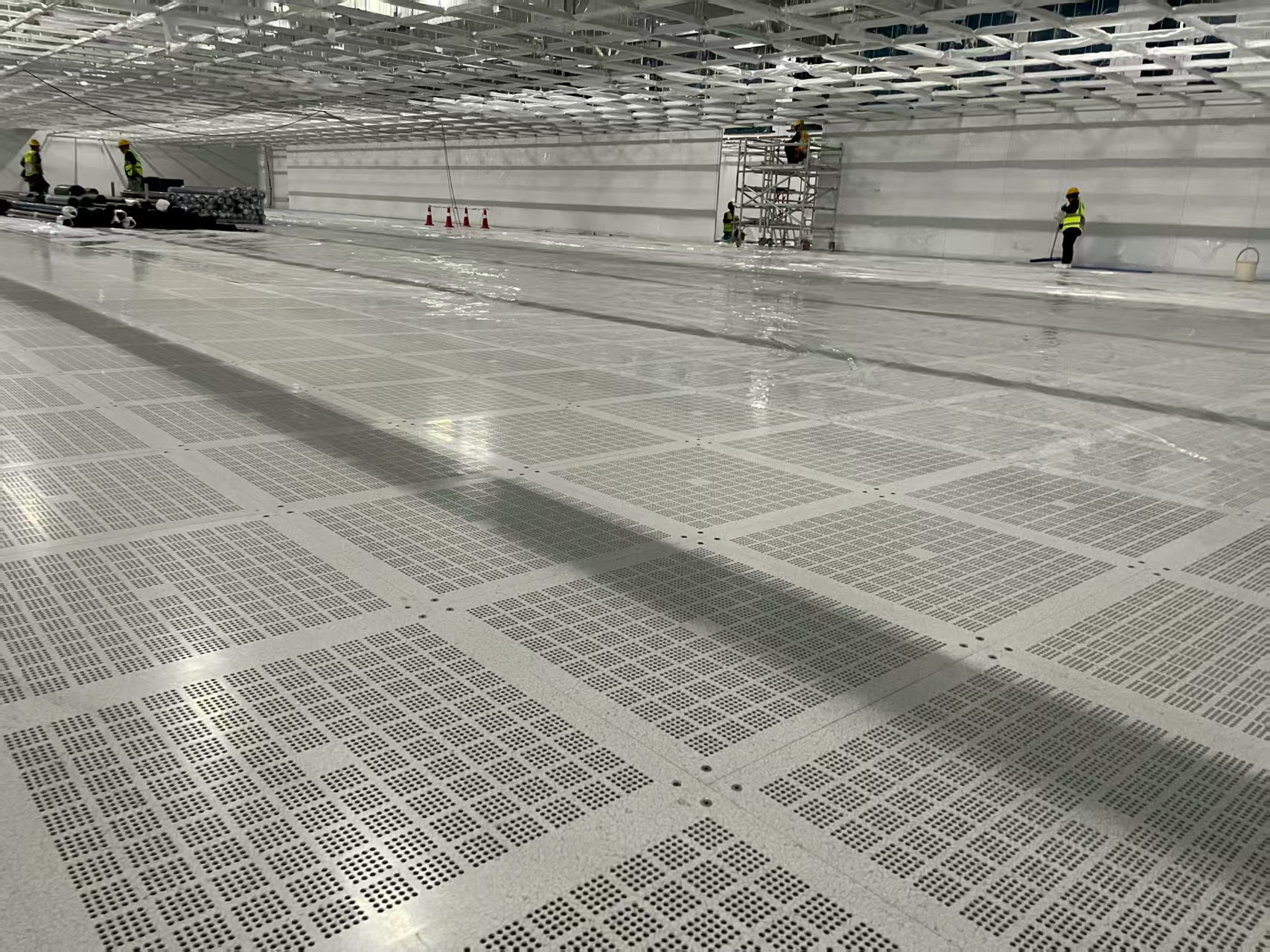
In high-precision assembly lines, static charge can wreak havoc long before anyone notices a spark. The real challenge isn't just dissipating that charge—it's doing so while the control surface gets walked on, rolled over, or pressed by heavy tooling. Flimsy coatings crack, peel, and lose their grounding path. What holds up are dense, homogenous layers engineered to maintain consistent resistance values even after thousands of load cycles.
That kind of durability comes from material choices most spec sheets gloss over. Instead of relying on a thin topical treatment, the static-dissipative properties are built through the entire thickness. Scuffs, scratches, and compression don't create dead zones. Even under point loads from machine feet or pallet jacks, the path to ground remains stable—so sensitive boards and volatile powders don't suddenly find themselves in an unprotected pocket.
Field testing tends to expose the difference quickly. Surfaces that bend or flex under pressure often show resistance spikes at the exact spots where contact is most aggressive. A properly formulated static control layer absorbs that mechanical stress without shifting its electrical behavior. It stays flat, stays predictable, and keeps the work area within safe limits without constant re-coating or replacement.
Grounding Connections That Stay Tight After Years of Use
Vibration and thermal cycling are the usual culprits behind loose electrical connections, but the design here counters both with a combination of serrated contact surfaces and a locking mechanism that resists micro-rotation. Over time, the metal-to-metal interface actually beds in slightly, increasing contact area rather than degrading it. This means you won't find yourself retightening terminals during routine maintenance, even on equipment that runs hot and cold through harsh duty cycles.
The secret lies in how the clamping force is distributed. Instead of relying on a single point of pressure, the connection spreads load across a wider footprint, which reduces stress relaxation in the conductor. Repeated thermal expansion doesn't cause the same loosening you'd see with a standard bolted joint. Field reports from industrial installations show these joints maintain their specified torque values after thousands of hours, without any sign of fretting or oxidation at the contact zone.
For anyone who has dealt with intermittent faults caused by a connection that works loose over time, the difference is immediately noticeable. You install it once, torque it to spec, and then forget about it. That reliability comes from a deliberate material pairing and geometry that prevents the slow creep and galvanic corrosion that plague lesser designs. It's the kind of detail that doesn't show up on a spec sheet but pays off every single day the system stays energized.
Why Corrosion Resistance Matters More Than You Think
Most people assume corrosion is just an eyesore—a bit of rust here, some tarnish there. But the real cost runs far deeper. When metal components degrade, they lose structural integrity long before visible damage appears. A bridge that looks fine from a distance might have load-bearing bolts quietly thinning underground. In chemical processing, a corroded valve can fail without warning, releasing hazardous materials. The problem isn't the surface rust you see; it's the microscopic pitting and stress cracking you don't.
Beyond safety risks, corrosion quietly drains budgets. Equipment replacement, unplanned downtime, and preventive coatings add up fast. Industries often accept these as unavoidable operating costs, but smarter material selection changes the equation. A stainless alloy or engineered polymer might cost more upfront, yet it eliminates frequent part swaps and labor-intensive inspections. The hidden savings appear in extended service intervals and fewer emergency shutdowns.
Then there's the environmental angle. Corroded storage tanks leak, pipelines rupture, and contaminated runoff enters soil and water. Regulatory fines and cleanup costs dwarf the price of corrosion-resistant materials. When you factor in reputation damage and potential legal liability, the case becomes clear: investing in corrosion resistance isn't a luxury—it's a long-term survival strategy for any operation that relies on metal infrastructure.
Snap-Together Panels, Serious Static Protection
Instead of wrestling with screws or adhesives, you simply line up the edges and press until the interlocking tabs click. That mechanical connection stays tight even when panels get bumped or rearranged. But the real payoff is on the surface: a static-dissipative layer pulls stray charges away from sensitive components before they can do damage.
The snap design also cuts setup time without cutting corners on safety. Each joint maintains a continuous path to ground, so there's no gap where a spark can sneak through. Whether you're assembling a bench in a packed repair shop or reconfiguring a cleanroom on short notice, the panels hold firm and keep your work zone within safe voltage limits.
Maintenance is just as straightforward. If one panel gets scratched or contaminated, pop it out and click a replacement into place — no downtime for curing or complicated disassembly. Static protection that's this easy to install and swap means the workspace stays both flexible and reliably grounded.
From Semiconductor Fabs to Data Centers: Where This Floor Belongs
In semiconductor fabs, the floor isn't just a surface—it's part of the process. Static discharge can destroy a wafer, vibration can throw off lithography, and a single particle can ruin an entire batch. This floor is built to keep all of that in check, with static-dissipative properties, tight panel seams, and enough rigidity to support sensitive equipment without flexing.
Shift to a data center and the priorities change, but the floor still has to work hard. Raised panels create a plenum for cold air to reach hot server racks, while also hiding power and data cables. The load rating matters here too—fully loaded cabinets can exceed 2,000 pounds per square foot, so the floor must handle that without sagging or rattling.
What links both spaces is the need for access and adaptability. In a fab, you may need to reconfigure tool layouts or run new gas lines. In a data center, you're constantly swapping cables and adding capacity. This floor is designed for that kind of continuous change, with panels that lift easily and a grid that stays stable over years of service.
FAQ
The panels have a conductive surface that channels static charges to a grounding point before they can build up and damage equipment. The aluminum core also provides consistent electrical continuity across the entire floor.
You'll often see them in server rooms, data centers, electronics manufacturing, cleanrooms, and labs where even a small electrostatic discharge can ruin components or disrupt operations.
Aluminum alloy panels offer high load-bearing capacity while staying lighter than steel options. Depending on the panel design and understructure, they can support rolling loads from equipment cabinets or heavy machinery without deforming.
Unlike coatings that wear off over time, the conductivity in aluminum alloy panels is built into the material itself. As long as the grounding system is intact, the static-control properties remain stable through years of use.
Routine care is straightforward—damp mopping with a neutral cleaner keeps the surface clean without leaving insulating residues. Avoid waxes or oil-based polishes because they can interfere with the conductive path.
Yes. Aluminum alloy panels resist particle shedding and can be made with sealed surfaces to meet cleanroom standards. They also stand up well to frequent cleaning and disinfecting without corroding.
The panels rest on grounded pedestals or stringers, and static charge flows from the surface through the panel body to the understructure, then to a building ground. Proper installation and periodic continuity checks keep the path effective.
Compared to steel or wood-core panels, aluminum alloy offers a better strength-to-weight ratio, natural corrosion resistance, and consistent conductivity without relying on surface adhesives that can peel or degrade.
Conclusion
Aluminum alloy doesn't need a special topcoat to carry static away. The metal's free electrons provide a natural path to ground, so even if surface finishes wear down over time, the dissipative performance remains intact. This matters in high-traffic areas where heavy equipment moves constantly. The panels are engineered not to flex or buckle under point loads, which keeps the conductive path unbroken from the top surface down to the grounding grid. Threaded grounding inserts are pressed into the panel corners and torqued to spec, so they won't loosen after years of vibration or thermal expansion cycles. Unlike some systems that depend on adhesive copper strips, these connections stay mechanically tight, maintaining a stable ohmic value over the life of the floor.
That mechanical stability pairs with corrosion resistance. In humid cleanrooms or near process chemicals, the aluminum forms a dense oxide layer that actually protects the substrate rather than degrading the electrical bond, provided the contact points are properly designed with serrated washers or conductive paste. Installation is straightforward: panels snap together with interlocking edges that guarantee metal-to-metal contact without additional tools or messy conductive adhesives. This makes the floor practical for semiconductor fabs, where even a small electrostatic discharge can ruin wafers, and for data centers, where thousands of server racks need a reliable reference ground to prevent hardware lockups. The result is a floor that doesn't just pass an initial resistance test—it holds its static control properties under real conditions.
Contact Us
Contact Person: yuki
Email: [email protected]
Tel/WhatsApp: +86 18664390732
Website: https://www.lipinfloor.com/