

Best Heat Resistant Conveyor Belt Options for High-Temperature Industrial Applications
2026-11-16
Most heat-resistant conveyor belts look similar on a spec sheet, but their behavior under sustained high temperatures can be completely different. That gap is where costly unplanned downtime begins—and also where the best choices stand out. Below, we compare practical options for high-temperature industrial applications and include YUFENG, a brand designed with these thermal demands in mind.
What Breaks First When a Conveyor Belt Gets Too Hot
Heat usually finds the weakest link in the belt splice before the cover shows serious damage. Vulcanized joints rely on cured rubber to grip the carcass plies or steel cords, and once surface temperatures climb past the compound's service limit, that bond starts to soften. The result isn't always a sudden snap; more often the splice edges begin to lift or the joint develops a soft, spongy zone that soon turns into a flap catching on scrapers and skirting.
If the heat is concentrated along the carrying side, you'll see the rubber deform or blister before internal damage becomes obvious. Small blisters and glazed patches are early signs that the cover compound is losing its oil and flex agents. At this stage the belt may still track and carry load, but the surface hardens fast as it cools, which leads to cracking at the trough line and shorter life even after temperatures return to normal.
Pulley lagging and bearing seals are usually next in line. A hot belt dumps heat directly into head and bend pulleys, where bonded lagging can peel loose and bearings can cook their grease into a thin, dark runoff. Once a bearing runs dry or the lagging slips, local heating accelerates and can take out a roll, shaft, or splice in a matter of hours.
Cover Compounds That Keep Working After Standard Rubber Fails
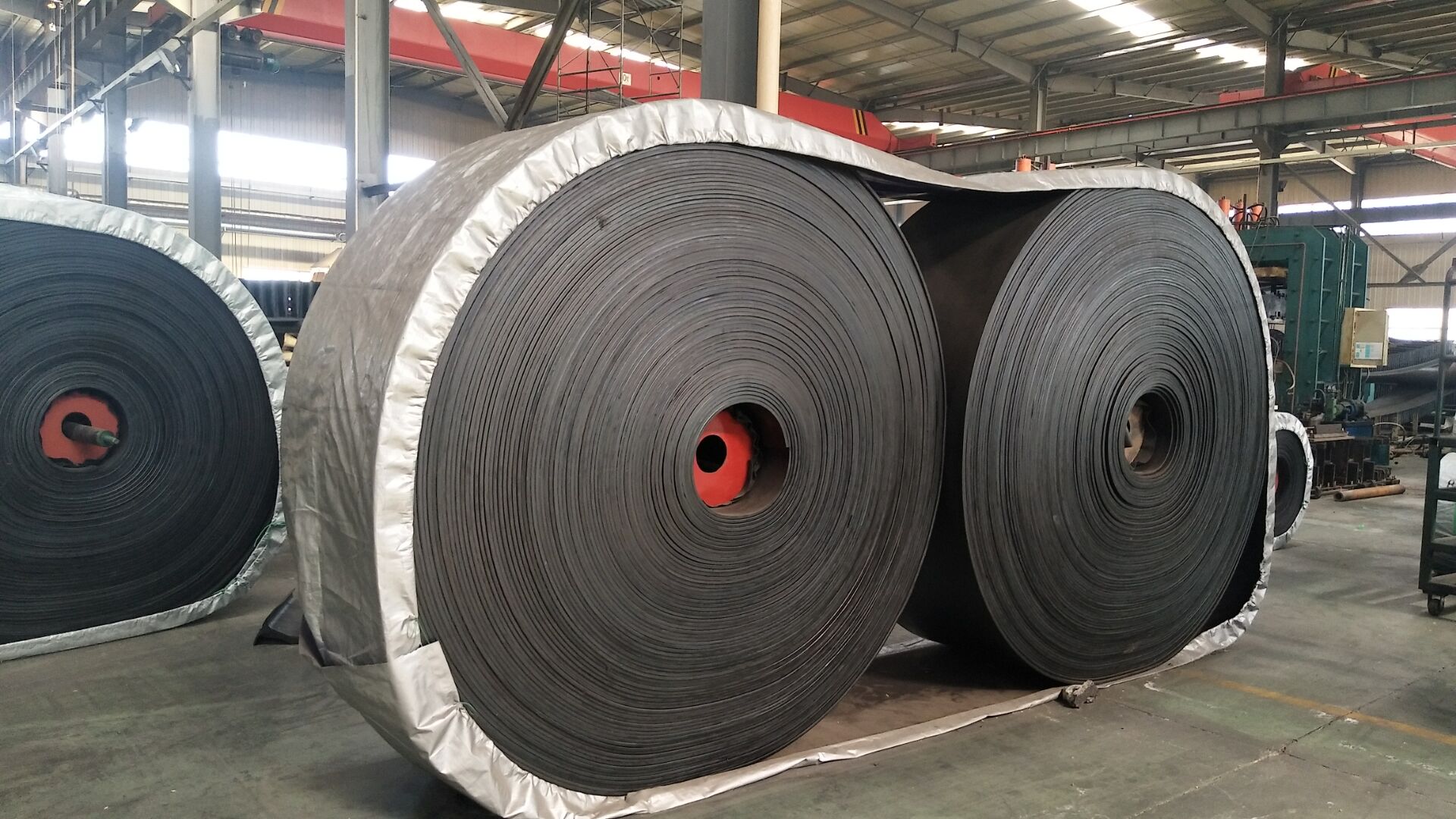
Standard rubber has a habit of quitting at the worst possible moment. It hardens with heat, turns brittle under ozone, swells in aggressive fluids, and loses its grip on metal and fabric once cracks start to spread. Cover compounds designed for those failure points don't simply delay the damage; they're built around different polymer chemistry so the surface keeps sealing, flexing, and absorbing impact long after a conventional rubber sheet would have split open.
In chute liners, pump casings, and conveyor skirting, the difference shows up in the details. A high-solids slurry that chews through natural rubber in weeks can be handled by a urethane-modified cover compound with better cut resistance and lower friction. Where standard rubber stiffens in cold storage, a plasticizer-free formulation stays flexible enough to maintain contact pressure without cracking. And in areas exposed to vegetable oils or dilute acids, chemical resistance doesn't come from a thin top coat that wears away; it's built through the full thickness.
The real test is not a lab sheet. It's the part that keeps protecting a splice or flange when the original rubber cover has already failed in the same environment. That kind of service life comes from matching the compound to the specific wear mechanism—abrasion, hydrolysis, thermal cycling, or edge tearing—rather than using one general-purpose blend. When standard rubber falls apart, the replacement should still be holding its shape, and its seal, under load.
Why Peak Temperature Numbers Don't Reflect Real Service Life
The datasheet gives you a single number, often derived under idealized conditions that rarely survive contact with an actual product enclosure. That peak temperature rating assumes uniform heat spreading, unlimited airflow, and a test board built specifically to make the part look good. In real life, neighboring components, potting materials, and thermal interface inconsistencies pull the junction temperature away from that controlled scenario. The number becomes a polite fiction long before your first field failure shows up.
What actually limits service life is not the headline figure but the accumulated time spent slightly below it. A part rated for 175°C may survive brief excursions, yet operating continuously at 155°C in a cramped housing can degrade wire bonds, accelerate electromigration, and shift parameters well before the advertised ceiling is ever reached. Reliability curves are not cliffs; they are slopes, and the slope gets steeper the longer you dwell in the upper third of the range. The peak number hides this by focusing attention on a single catastrophic event instead of the slow, quiet drift that kills most assemblies.
Moreover, thermal cycling stress rarely shows up in a static maximum rating. Every power-on and power-off cycle expands and contracts materials at different rates, cracking solder joints and delaminating interfaces even when the measured temperature never approaches the allowed maximum. Designers who fixate on the peak overlook the damage being done at 100°C repeated ten thousand times. The real service life emerges from the temperature history you actually create, not from a boundary condition printed on page one of the spec.
Carcass Choices for Heat That Never Lets Up
When the pavement shimmers and even the shade feels like a slow exhale, the cut you pick matters more than the thermostat. Heavier marbling turns into a liability on a blistering afternoon — those rich fat seams render too quickly, leaving you with a chew that sits like a wool blanket. Instead, look for leaner, denser muscle groups that hold their structure when the heat climbs: flank, skirt, or a well-trimmed sirloin tip. These carcass sections don't collapse under ambient temperature, and they reward a fast, high-heat sear with a crust that actually snaps.
There's also a quiet advantage in choosing smaller-framed animals during a heat wave. Lambs and goats, with their thinner fat cover and quicker rigor resolution, tend to stay fresher on the rail when the walk-in struggles. The same logic applies to a whole hog: the shoulder and fresh ham lose less moisture than the belly, which can weep and turn tacky before noon. If you're breaking down the carcass yourself, work in the early hours, keep a spray bottle of cold water nearby, and let the bones guide your knife — heat makes the fascia more forgiving, but only if you move before the surface proteins start to set.
Don't overlook the value of a dry exterior. A carcass that has been air-dried, even for a few hours, resists the sticky film that humidity encourages. That's why a salt-and-air rest before cutting, or hanging the primals near a slow fan, changes the texture of the final bite. The point isn't to fight the weather — it's to choose cuts that treat the heat as a tool rather than an enemy, then handle them with enough speed and salt to keep the flavor bright instead of sluggish.
How Steel Mills and Cement Plants Handle High-Temperature Conveying
At a cement plant, a conveyor carrying clinker out of the cooler often runs beneath material that still holds 200–400°C, and nobody thinks twice about it until a splice lets go. The first line of defense is usually the belt cover compound. EPDM-based covers handle dry heat well, while chlorobutyl or SBR compounds get mixed in where hot fines and occasional lumps sit directly on the belt. For temperatures beyond roughly 180°C, a belt alone rarely survives without help, so many mills switch to heat-resistant steel cord belts with a thicker top cover and accept shorter replacement cycles as normal maintenance.
Steel mills face a sharper version of the same problem. Hot strip, slabs and sinter can arrive at a transfer point glowing faintly, and the conveyor has to shed that heat before it soaks into bearings, idlers and structural steel. A common fix is to keep material moving rather than letting it pool, using impact beds with low-friction strips and spacing idlers more tightly near the load zone. Some lines also add radiant heat shields or water-spray cooling, but water is used carefully because quenching hot slag too fast can create steam pockets that damage chutes and covers.
The less obvious work happens in chute design and maintenance planning. A chute that lets material slide instead of taking a straight drop reduces impact and spreads the thermal load over a longer section of belt. Ceramic liners or replaceable wear plates take the abuse instead of the belt top cover. Crews also watch for localized hardening of the rubber surface, edge cracking and splice softening, since these are the early signs that a belt is being cooked from the outside in. In both industries, handling high-temperature material well usually means designing for the hottest 10% of loads and replacing parts on a schedule, not on a failure.
Alignment and Tension Adjustments That Prevent Early Heat Failures
Misalignment rarely announces itself with noise at first. A shaft running just a few thousandths out of parallel adds constant side load to bearings, and the extra friction shows up as housing temperatures that creep upward over a shift. Checking runout across coupling faces and rim positions before locking bolts, rather than trusting the last shutdown's settings, catches the drift that thermal growth creates in the frame. When everything is pulled back to the same plane under normal operating temperature, heat stabilizes without continual lubrication fixes.
Tension is often set by feel, and that is where early failures begin. An over-tight belt or chain keeps the driven shaft under a bending load, forcing grease to work harder and the rolling elements to run hot. Under-tensioning may slip just enough to polish contact surfaces and create hot spots without any obvious squeal. Using a tension gauge or frequency meter after the first few run-hours, then rechecking once the new components have seated, removes the guesswork that leads to localized overheating.
The practical approach is to treat alignment and tension as a paired check, not separate tasks. After any replacement, leave the mounting bolts slightly snugged, rotate the assembly a few full turns by hand, and watch how the tensioned member seats itself before final torque. Recheck both after the machine reaches load, because cold alignment can become hot misalignment. Small corrections at that stage are usually enough to keep heat-related failures from becoming a recurring repair order.
FAQ
Manufacturers typically group belts into T1, T2, and T3 or similar HR, SHR, and XHR tiers. T1 suits continuous material temperatures around 100–120°C, T2 handles 130–150°C, and T3 can run at 160–200°C, sometimes up to 220°C for short excursions. Above roughly 250°C, the splice and adhesive layers usually become the limiting factors, so steel slat, wire mesh, or chain conveyors often make more sense.
EPDM generally ages far better than SBR or natural rubber in hot, dry conditions and can remain flexible at around 160–180°C. For intense radiant heat or heavy exposure to hot fine dust, butyl and chlorobutyl covers are worth a look because they offer good thermal stability, though they may sacrifice some abrasion resistance. If hot oil or grease is also present, a chloroprene blend is often a safer compromise than straight EPDM.
Fabric belts usually handle thermal expansion and contraction more gracefully, making them a practical choice for short to medium hauls and moderate material temperatures. Steel cord belts carry more tension and work better on long or high-lift runs, but the steel conducts heat into the core, so a thick heat-resistant cover and properly built splices become critical. If the application is high tonnage over a long distance, steel cord wins; otherwise fabric is often easier to maintain.
Material temperature alone can be misleading. A large hot lump may only touch a small part of the belt, while the rest of the surface stays much cooler. Fine hot dust or a deep continuous bed can do the opposite and keep the surface near the actual material temperature for long stretches. An infrared reading across the belt profile gives a realistic picture of whether the cover, plies, and splice are staying within safe limits.
Lower drop height, add impact idlers or a loading cushion, and keep skirts sealed so hot fines do not pack against the belt. A rock box or leveling plate at the transfer point spreads the material stream and prevents one concentrated hot spot from baking the same section. Some plants use controlled air cooling or a light water spray before the belt, but water needs careful management because steam and thermal shock can create their own problems.
Cement plants, steel mills, foundries, glass factories, power stations, and asphalt operations are the heavy users. They routinely handle clinker, sinter, castings, cullet, bottom ash, or hot mix that would crack and delaminate a standard belt within weeks. Lighter versions also appear in bakeries and food dryers, but the demanding cases are almost always heavy bulk material at elevated temperature.
The cover is only part of the story. Heat-resistant belts need adhesives and skim compounds that do not soften or degrade under repeated thermal cycles, and the splice materials must match that rating. Many designs add a breaker layer or adjust the edge sealing to keep hot fines out of the carcass. A belt that only gets a heat-resistant top cover may look fine initially but fail early between plies or at the splice.
Keep tracking and tension correct because a belt wandering near hot equipment deteriorates quickly. During planned shutdowns, inspect for blisters, surface cracks, edge delamination, and splice damage, and use an infrared thermometer or thermal camera to find uneven hot areas across the cover. If the belt has to stop while loaded and hot, try to run it empty for a few minutes first so heat does not sit in one place and accelerate cover aging.
Conclusion
In high-temperature conveying, the first failure point is usually not the belt core but the cover compound. Standard rubber stiffens, loses elasticity, and cracks long before the carcass breaks down, so heat-resistant selection has to begin with cover chemistry. Compounds based on EPDM, chlorobutyl, or heat-stabilized SBR blends keep working after ordinary rubber turns brittle and surface checking appears. At the same time, peak temperature ratings on a data sheet rarely reflect actual service life. A belt marked for 200°C may survive short contact with hot material but fail quickly under continuous exposure at a lower temperature, especially when thermal cycling weakens the rubber over time. The practical measure is not the highest number on paper, but how long the cover stays flexible and crack-free under repeated heating and cooling.
Carcass selection becomes equally important when heat never lets up. Polyester-nylon constructions are common, but steel cord or aramid may be required where tension retention at sustained temperatures is critical. Steel mills and cement plants typically avoid depending on one high-temperature belt alone; they rotate spares, monitor hot spots, and accept shorter replacement intervals in severe zones. They also pay close attention to alignment and tension because thermal expansion changes tracking behavior. Edge wear, pulley lagging damage, and splice creep often appear first when a hot belt drifts. Making regular alignment and tension adjustments can prevent early heat-related failures more effectively than simply choosing a higher temperature class.
Contact Us
Contact Person: Jayce
Email: [email protected]
Tel/WhatsApp: 8615318787602
Website: https://www.yuphengbelt.com/