

Best Sintered Silicon Carbide Materials for High-Performance Industrial Components
2026-11-19
Why do two silicon carbide seals fail at very different hours? The answer usually sits in the sintered microstructure: density, grain size, and phase composition. For high-performance industrial components, the best sintered silicon carbide materials are not just about material data sheets; they are about repeatable production and honest quality control. HUAYI TECH has focused on exactly that intersection: materials that hold up under wear, high temperature, and aggressive chemicals. This guide breaks down what to look for, what to avoid, and why the right SiC grade changes the cost-per-hour of critical equipment.
How Sintered SiC Holds Up Under Friction When Other Materials Fail
Run a standard alumina shaft against a sintered silicon carbide face and the failure mode is rarely the SiC. The material's hardness sits just below diamond on the Mohs scale, but hardness alone doesn't explain its friction behavior. What makes sintered SiC unusual is how a tribo-oxide film forms under load. As the surface heats from sliding contact, a thin, glassy layer of silicon dioxide develops. That layer acts as a solid lubricant, lowering the coefficient of friction even as mating parts start to degrade.
Compare this with tungsten carbide or hardened steel. Under dry or boundary-lubricated conditions, those materials tend to gall or transfer material when the oil film collapses. Sintered SiC resists that because its grain boundaries are locked tight during pressure-assisted densification. There is no metallic binder to smear, no soft phase to plow out.Even when a hard particle gets trapped between the faces, the SiC surface tends to polish rather than gouge, which keeps the friction coefficient stable over millions of cycles.
The practical result shows up in mechanical seals and pump bearings where process fluids lose lubricity. Alumina cracks under thermal shock, reaction-bonded SiC can wear unevenly due to residual silicon, and cemented carbides fail from binder leaching. Sintered SiC holds its surface finish because the wear mechanism shifts from abrasion to tribochemical polishing. That is why engineers swap to it after short-lived failures elsewhere: the friction stays predictable when everything around it is chewing itself apart.
Direct-Sintered and Reaction-Bonded Grades Compared for Heavy Industry
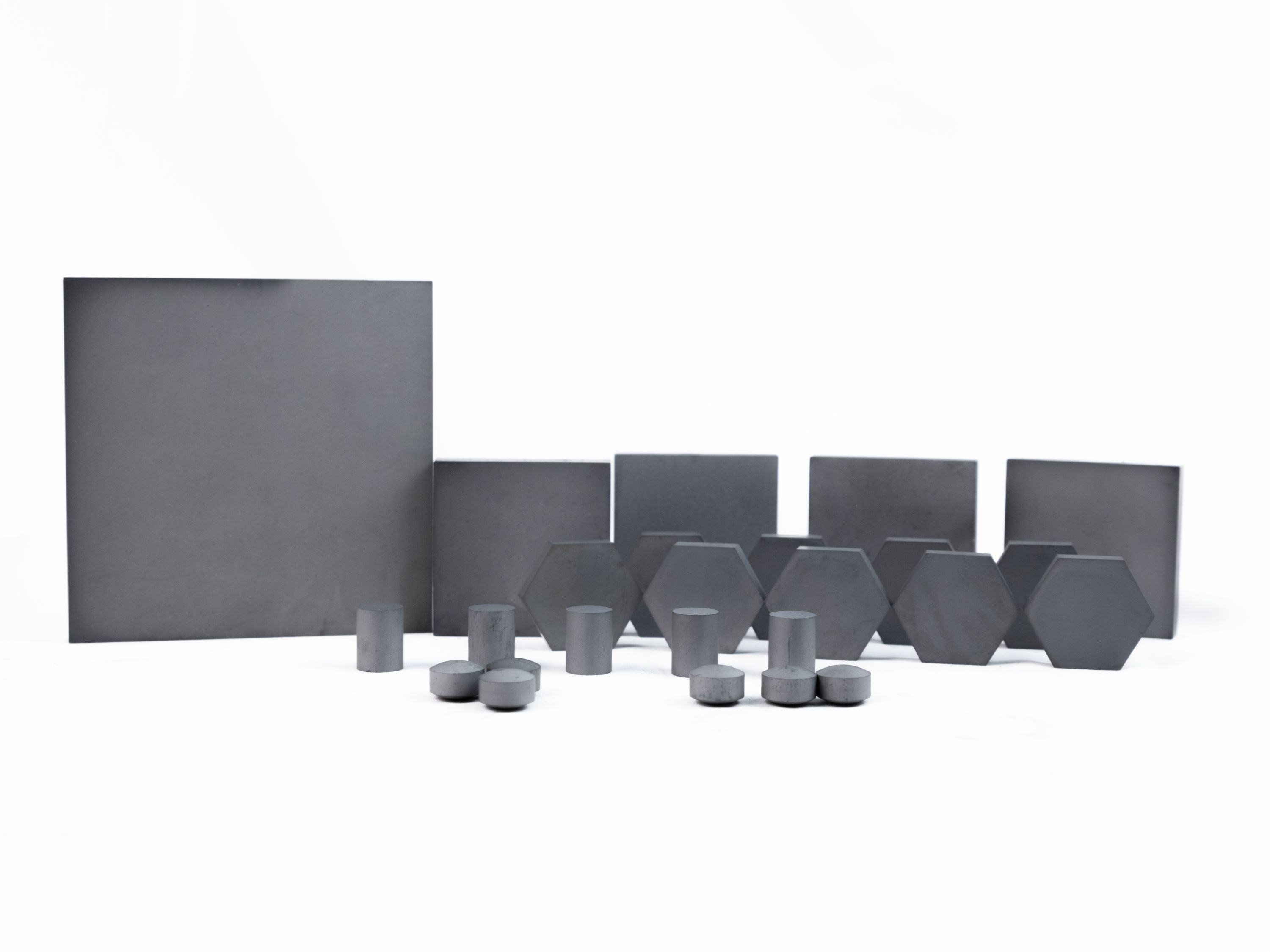
In heavy mineral processing and power generation, direct-sintered silicon carbide tends to be the first choice when temperatures climb beyond what reaction-bonded grades can sustain. The absence of free silicon gives it a cleaner grain boundary, so wear faces stay intact in hot, oxidizing flue gas streams and in pump seals running against hard mating rings. It is also slightly harder and less prone to galling, though the trade-off shows up in complex shapes, where machining is slow and scrap rates climb.
Reaction-bonded silicon carbide earns its place when component geometry becomes unfriendly to grinding. Because the near-net-shape process survives firing with very little shrinkage, foundries can cast large impellers, burner nozzles, and liners with internal channels that would be impractical to machine from a direct-sintered billet. The fine dispersion of residual silicon also closes porosity, which helps in high-pressure slurry piping where fluid loss or cavitation damage is a concern.
The better grade usually depends on the failure mode a plant is trying to eliminate. Direct-sintered material handles thermal shock and abrasive media at high velocity with less surface degradation, while reaction-bonded material reduces lead time and cost for bulky, intricate parts where leaks and wall thickness matter more than extreme hardness. Many maintenance teams run both in parallel, reserving each for the operating window where its microstructure stops being a compromise and starts being an advantage.
Seals, Bearings, and Impellers That Benefit Most from Silicon Carbide
Silicon carbide brings a notable edge to rotating equipment, but the gains are not spread evenly across every component. Seals, bearings, and impellers stand out because they operate under constant friction, thermal stress, and exposure to abrasive or corrosive media. In these parts, the material's hardness works as a practical advantage rather than a marketing point. A silicon carbide seal face resists scoring even when the fluid film thins momentarily, while the same rigidity that makes the material brittle in bulk becomes an asset in a thin, supported ring.
Bearings made from silicon carbide tend to show their worth in submerged or dry-run scenarios. The low coefficient of friction against carbon or itself reduces heat buildup, and the material's stiffness keeps clearances stable when pumps cycle through temperature swings. Impellers, on the other hand, benefit less from the material's self-lubricating traits and more from its erosion resistance. Slurries and particle-laden fluids chew through metallic alloys, yet a silicon carbide impeller can maintain its vane geometry long enough to preserve hydraulic efficiency.
What ties these three components together is the margin for error they gain. A seal that survives a brief loss of lubrication, a bearing that tolerates a contaminated lubricant, an impeller that shrugs off fine sand—each avoids a failure that would otherwise cascade. For maintenance teams, that translates into fewer unplanned teardowns and a clearer picture of when parts actually need replacing instead of when they might fail.
Why Grain Size and Density Control Crack Resistance in SiC Parts
The reason grain size and density matter so much for crack resistance in SiC components comes down to how cracks actually form and travel. A fine, uniform grain structure distributes stress across many boundaries instead of letting it concentrate at a single weak point. When grains are smaller, a crack that tries to propagate hits a boundary more often and has to change direction repeatedly, which drains its energy. Dense material adds another layer of protection: porosity acts like a string of pre-made flaws. Each pore can serve as a starting point for a crack under load or thermal cycling. Reducing that porosity raises the critical stress intensity needed before any flaw becomes dangerous, so the part survives conditions that would shatter a less dense version.
There is a practical side to this as well. Sintered SiC often shows a direct link between final density and measured fracture toughness. If grain growth runs out of control during processing, the resulting large crystals create long, straight paths for cracks to follow almost unimpeded. That is why careful control of sintering temperature and time is not just a quality checkbox; it directly determines whether the part can handle sudden thermal shock or mechanical impact. In applications like seal rings or armor tiles, the difference between a 97% dense part and a 99% dense part can be the difference between a component that chips at the edge and one that holds up for years.
What makes this worth paying attention to is that grain size and density do not act independently. A part can have small grains but still fail early if it is full of closed porosity, because those voids act as stress concentrators regardless of grain refinement. Conversely, a fully dense part with abnormally large grains may show good hardness but poor resistance to crack initiation. The best crack resistance comes from balancing both: enough densification to eliminate interconnected pores, and a microstructure fine enough that any crack has to work hard just to grow a few micrometers. That balance is what separates a generic SiC part from one designed for repeated thermal and mechanical abuse.
Chemical Resistance and Thermal Shock in Corrosive Process Equipment
Corrosion rarely acts alone in process equipment. A vessel that survives a strong acid at ambient temperature can fail catastrophically when the same medium cycles between hot and cold. The material’s passive oxide layer may crack under thermal stress, exposing fresh metal to the aggressive environment. Engineers who select alloys based only on static chemical compatibility often miss this combined failure mode, where the rate of wall thinning accelerates after each thermal event.
Thermal shock magnifies existing micro-defects in linings, welds, and gasket seating areas. For example, a fluoropolymer-lined carbon steel reactor may handle hydrochloric acid well during steady operation, but rapid steam-out followed by cold feed can delaminate the lining at the flange faces. Once the corrosive liquid reaches the steel shell behind the liner, the damage is hidden until a leak develops. Effective designs therefore pair chemical resistance with controlled heating and cooling rates, and they include inspection points that can reveal early thermal fatigue cracking before it becomes a process safety issue.
Practical material selection looks at both corrosion allowance and the maximum permissible temperature swing per cycle. Glass-lined steel, for instance, offers excellent acid resistance but demands a modest thermal gradient limit to protect the glass-to-steel bond. Ceramic and silicon carbide components tolerate wider swings yet carry higher initial cost and brittleness considerations. The most reliable systems often combine materials: a chemically resistant wetted surface, a thermally compliant intermediate layer, and a structural outer shell designed to absorb expansion mismatch without transferring stress to the corrosion barrier.
Matching a Grade to Abrasive, Acidic, and High-Temperature Conditions
Matching a grade starts with identifying which condition actually controls failure. An abrasive slurry in a low-pH stream can chew through a hardened steel just as quickly as it pits a lower-hardness stainless, but for different reasons. If erosion is dominant, hardness and carbide volume matter; if acid attack is the main threat, chromium, molybdenum, and nickel content become more important. The mistake is treating the harshest single variable as the only variable, because acidic films can soften a wear-resistant surface and fine particles can strip a passive layer before it reforms.
Where abrasion and acidity overlap, duplex stainless grades and some nickel alloys often sit in a useful middle ground. They do not match the raw hardness of a high-carbon martensitic steel, but they keep enough toughness and corrosion resistance to avoid sudden pitting or stress cracking. In high-temperature acidic slurries, molybdenum and nitrogen additions help preserve the passive film, while the base material needs enough strength at temperature to resist flow and deformation. A hardfacing that works at ambient temperature may lose bond strength or crack if the substrate expands differently when heated.
For high-temperature abrasive conditions, cobalt-based alloys and certain ceramics are common references because they retain hardness and resist oxidation better than many tool steels. Even so, grade selection should be tied to the actual temperature window, particle size, and acid concentration rather than a generic “severe service” label. Small changes in pH or chloride level can shift the better choice from a cobalt-chromium hardfacing to a nickel-based alloy or a ceramic insert. Pilot testing under the real combination of heat, acidity, and abrasive load remains more reliable than extrapolating from separate corrosion and wear charts.
FAQ
Hardened steel tends to wash out quickly in abrasive slurries, while sintered silicon carbide keeps its surface finish far longer because the hardness is close to diamond and the material resists erosion from fine particles. The payoff is less frequent rebuilds and tighter internal clearances over the life of the pump.
Pressureless sintered grades usually deliver the best mix of density and shape capability for complex parts. Hot pressing pushes density and strength even higher but limits geometry. Reaction bonded material can be made thick and near-net, though it sacrifices some corrosion resistance because of residual free silicon.
The main limitation is brittle fracture under impact or severe thermal shock. If the system sees sudden temperature swings or mechanical shock loads, the part can crack instead of bending. Careful mounting, gradual heat-up, and avoiding point loads matter more than with ductile metals.
Only with diamond tooling, and even then it is slow and expensive. Most components are pressed or cast close to final shape and then finish-ground only where tolerances demand it. Designing for as-fired dimensions is the practical way to keep cost down.
In inert or reducing atmospheres, high-purity sintered silicon carbide can operate above 1600°C, often around 1650°C depending on the grade. In oxidizing conditions the practical ceiling drops somewhat because of passive oxidation, but it still outperforms most metals and many ceramics.
Chemical processing, semiconductor manufacturing, and pump and seal producers are the big adopters. Also kiln furniture, thermal processing, and increasingly demanding automotive and aerospace applications where thermal stability and wear resistance justify the higher material cost.
Alumina is cheaper but softer and less thermally conductive. Tungsten carbide is tougher and extremely hard, but much heavier and more expensive for large parts. Sintered silicon carbide sits in a useful middle: lighter than tungsten carbide, harder and more heat-tolerant than alumina, with excellent corrosion resistance.
Not necessarily. Some seal faces and bearings are intentionally produced with controlled porosity to hold lubricant or tailor friction. For structural parts under high stress, however, residual porosity is usually unwanted because it lowers strength and gives corrosive media an easier path through the material.
Conclusion
Sintered silicon carbide earns its place in heavy-duty equipment not through a single property but through a combination that rarely shows up in one material. Under sliding contact, direct-sintered grades keep a low wear rate long after hard metals and alumina have scored or seized, partly because the surface forms a thin oxide film that acts as a solid lubricant without softening the substrate. Reaction-bonded SiC, by contrast, offers a finer balance of toughness and shape freedom for large pump bodies and complex liners, though it sacrifices some hardness and high-temperature strength compared with pressureless-sintered material. The practical choice usually comes down to whether the component sees abrasive slurry, sharp temperature swings, or both, and that decision is rarely as simple as picking the highest hardness on a datasheet.
Seals, bearings, and impellers show the biggest gains because they combine continuous rubbing with exposure to aggressive fluids. A fine, uniform grain structure keeps pores small and crack paths short, which is why pressed and sintered rings resist chipping when a pump runs dry or a shaft deflects. In chemical processing, silicon carbide is used where stainless alloys pit and graphite wears too quickly, handling sulfuric acid, hot caustic, and thermal shock in the same assembly. Matching a grade to the environment means reading more than the composition: grain size, sintering aid chemistry, residual porosity, and even the machining method shift the failure mode. A direct-sintered fine-grain material often works for high-speed seal faces, while a reaction-bonded coarse-grain part can survive a furnace rack or a large impeller where thermal-cycling stress matters more than peak hardness.
Contact Us
Contact Person: Junting Leo
Email: [email protected]
Tel/WhatsApp: +86 18615009766
Website: https://www.huayimaterial-china.com/