

Custom Hollow Wall Winding Pipe Machine Enhances Manufacturing Efficiency
2026-11-16
In an industry where every second of downtime translates directly into lost revenue, manufacturers are constantly hunting for ways to squeeze more throughput from their production lines. But what if the pipe itself could be produced faster, stronger, and with far less waste—without requiring a complete overhaul of your existing setup? That's exactly the promise behind COMRISE's custom hollow wall winding pipe machines. By rethinking the winding process from the ground up, these systems are quietly reshaping how factories approach high-volume pipe production.
Tailored Winding Units That Trim Hours Off Every Pipe Run
Standard winding equipment often forces crews to wrestle with generic mandrels, shim stacks, and repeated guesswork just to get a clean lay on odd-sized pipe. Tailored winding units flip that script by matching arbor geometry, traverse pitch, and guide roller spacing to the exact outside diameter and wall thickness of the job. Because the setup arrives pre-dialed from the shop floor, the first wrap lands where it should instead of after a half-dozen test passes.
The real time savings come from smarter tension logic and synchronized carriage movement. Instead of an operator feathering a control valve or manually reversing direction at the pipe ends, these units read spool diameter in real time and adjust pull force on the fly. Edge buildup, loose wraps, and cross-overs that normally eat up an afternoon become rare events, so a run that used to require constant babysitting now finishes while the crew preps the next joint.
On multi-section projects, that difference compounds fast. A crew working with tailored units can knock out long straight runs, short nipples, and transition spools without stopping to swap tooling or re-tune tension for every diameter change. Superintendents notice fewer callbacks for coating damage and less fatigue-related slow-down near the end of a shift, which means the schedule stops slipping and pipe hits the trench hours earlier.
Custom Machine Geometry for Faster, Cleaner Pipe Wall Formation
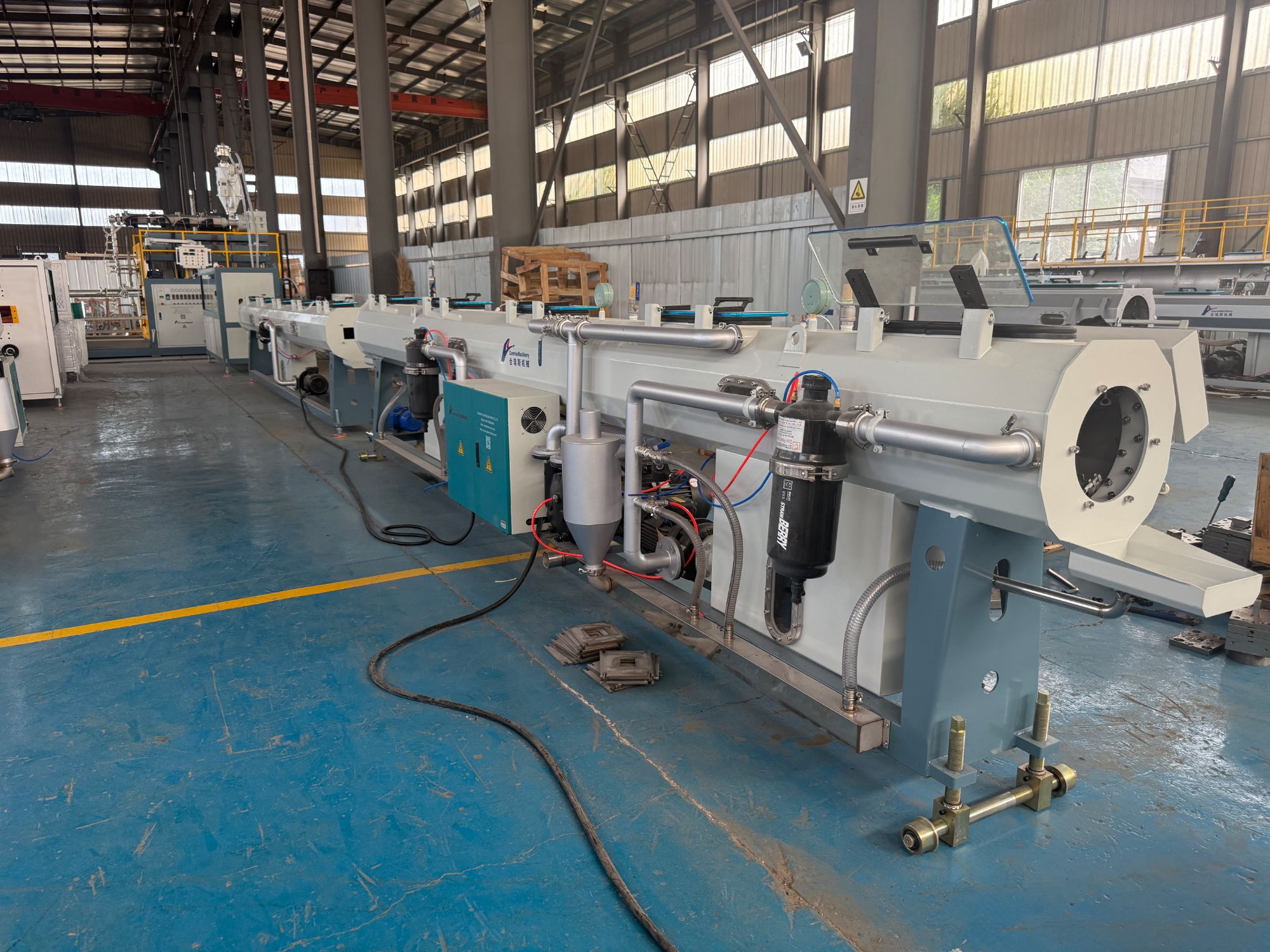
Pipe wall formation often suffers from uneven material flow and lingering residue when standard tooling angles force the polymer through abrupt transitions. By reshaping the mandrel and die land profiles, the melt stream can be guided along gentler curves that maintain consistent shear rates. This reduces internal stress and keeps the wall thickness uniform without relying on higher temperatures or slower line speeds.
A custom geometry also plays a direct role in cleanliness. Sharper, shallower convergence zones leave fewer dead spots where degraded material can accumulate, which means less burn-off and fewer black specks in the finished pipe. The smoother transition from barrel to calibrator allows the outer skin to set faster and with a tighter dimensional window, cutting down on post-extrusion sizing corrections.
Beyond the immediate quality gains, the right machine geometry shortens purge and changeover times because there is simply less surface area for stubborn remnants to cling to. Operators spend less time chasing contamination issues and more time running stable production. The result is a line that hits target wall thickness sooner after startup and holds that consistency through long runs, even when switching between grades or colors.
Smarter Heating and Cooling Zones Keep Output Steady
Traditional climate control treats an entire building as one uniform box, blasting warm or cool air regardless of where people actually sit or where machines generate heat. That blunt approach leads to constant temperature swings, wasted energy, and uncomfortable pockets that force equipment to work harder than necessary. The smarter alternative divides a facility into multiple heating and cooling zones, each with its own sensors and dampers. These zones respond to real-time conditions rather than a single thermostat reading in a hallway.
When output fluctuates because a server room heats up or a loading dock lets in cold air, the zoned system adjusts only the affected area. A nearby zone might stay completely idle while another ramps up airflow, preventing the whole building from overcorrecting. This granular control keeps ambient temperatures within a narrow band, which is critical for precision manufacturing, food storage, or any process where heat or cold directly affects product quality.
Operators often notice that steadier zone temperatures translate into fewer alarms, less compressor cycling, and longer equipment life. Instead of fighting broad swings, the system fine-tunes small deviations before they become problems. That steadiness also helps workers stay comfortable without constantly fiddling with local thermostats. In the end, smarter zoning isn't about adding complexity—it's about letting each part of a building manage its own thermal load so the overall output never drifts.
Less Scrap, More Pipe: Where Material Cost Meets Design
Material waste often hides in plain sight—cutoffs pile up near the saw, trimmings spill from the bundle, and off-spec lengths get tossed without a second thought. But when pipe design ignores how standard stock sizes map to finished dimensions, every joint pays a quiet tax. The fix starts before the first cut: aligning nominal lengths, bending radii, and end treatments with what actually comes off the mill. That way, the floor stays cleaner and the cost per installed foot drops without touching the product's performance.
Designers who treat scrap as a design input rather than an afterthought find more room to negotiate. A two-inch adjustment in routing can turn a six-foot remnant into a usable drop, while a slight change in fitting type might let a full stick serve where a custom cut once ruled. These choices rarely show up on a drawing's face, but they show up on the bid tab and the project's bottom line. The best layouts look simple because they've already solved the waste problem upstream.
When material cost and design intent stop fighting, the result is a pipe run that uses nearly everything it touches. That doesn't mean compromising on strength, flow, or serviceability—it means knowing the stock list well enough to design around it. In the field, that translates to fewer dumpster hauls, faster installs, and a cleaner handoff from engineering to the crew. Less scrap isn't just a purchasing goal; it's a design signature.
Quick-Change Mandrels and Dies for Mixed-Order Production
In mixed-order production, every minute spent swapping mandrels and dies adds up fast. Quick-change tooling eliminates the usual fumbling with bolts, shims, and alignment checks, replacing them with a single locking mechanism that seats the tooling in seconds. Operators can move from one size or profile to the next without disrupting the line, keeping small batch runs profitable and on schedule.
The design relies on precision-ground locating surfaces and repeatable clamping pressure, so the setup stays rigid even at high cycle counts. Rather than re-zeroing each time, the system returns to the same reference points, cutting scrap and rework often tied to manual adjustments. This consistency matters most when order sequences shift daily and tooling changes become the norm rather than the exception.
For shops juggling dozens of part numbers in a week, the real gain isn't just speed, it's flexibility. A single press can handle a wider range of work without waiting on a dedicated setup crew. Less downtime between jobs means more output per shift, and less reliance on operator memory or written cheat sheets to get the tooling right.
Operator-Friendly Controls That Shorten Training and Boost Uptime
Industrial panels that bury essential functions under layers of menus force operators to memorize workarounds—and still make mistakes when rushed. Replacing that setup with a control surface that mirrors the actual process flow changes the learning curve. Large, color-coded start/stop buttons, a single-tap access to status screens, and clearly labeled alarm states let new hires run basic cycles after a half-day walkthrough instead of a week of shadowing. The goal is simple: the less time someone spends hunting for the right function, the less chance there is for a costly error.
Uptime improves when controls respond the way an operator expects. For example, a single glance at a bar graph for feed pressure or a flashing yellow indicator for a pending tool change removes guesswork. Critical alarms should stand out from routine notices, not blend into the same beeping list. When a machine pauses, the screen should already show the next step—release the interlock, clear the jam, or check a sensor—rather than forcing someone to scroll through diagnostic codes. This kind of real-time guidance keeps small issues from turning into unplanned shutdowns.
The payoff shows up in shift-to-shift consistency. Operators stop relying on tribal knowledge from a handful of veteran employees, and supervisors spend less time answering the same setup questions. Maintenance calls drop because the control system catches operator errors before they become mechanical failures. In practice, plants that adopt these straightforward interfaces often report that a newly trained crew reaches full output in days, not months, and that routine changeovers happen without a drop in throughput.
FAQ
The main difference lies in adaptability. A custom machine is built around your specific pipe diameters, wall thicknesses, material blends, and output targets, so you avoid forcing a generic design to handle tasks it wasn't meant for. That translates to fewer slowdowns and less scrap during production.
When the extrusion rate, cooling length, and winding speed are matched to your actual product range, the line runs closer to its optimal rhythm. Operators spend less time adjusting settings between runs, and the equipment isn't constantly pushed beyond its comfort zone, which keeps throughput high and energy use predictable.
Municipal drainage, sewage treatment, agricultural irrigation, and cable protection projects tend to see the biggest gains. Any operation that needs large-diameter, lightweight, high-ring-stiffness pipes can benefit, especially when order volumes justify tailoring the line to a narrow range of sizes.
First, define your core pipe sizes and expected annual output. Then look at the raw material you plan to use, whether virgin HDPE, recycled resin, or a mix. Finally, consider factory space and cooling capacity, because a well-matched downstream setup matters as much as the extruder itself.
Not necessarily. Because components are selected for your actual workload rather than a broad average, you often see less wear on screws, barrels, and drives. The key is keeping documentation clear and training operators on the specific configuration, which many suppliers include during installation.
It usually does when the alternative is buying a standard line and running it inefficiently. Faster changeovers, lower scrap rates, and reduced energy per meter of pipe add up quickly, and many users report recovering the premium within the first one to two years of full production.
In some cases, yes. Retrofitting a new die head, upgrading the control system, or replacing the winding unit can bring an older line closer to custom performance. However, if the frame, cooling bed, or haul-off are undersized for your target pipes, a full custom build is usually the more cost-effective path.
Conclusion
The shift to custom hollow wall winding pipe machines is changing how manufacturers approach pipe runs. Instead of forcing standard equipment to handle varied wall thicknesses and diameters, these machines use tailored winding units that adapt to each job. That alone trims hours off every pipe run. Custom machine geometry also plays a big role: the forming sections are shaped to match the exact pipe profile, so the wall builds up faster and with fewer surface defects. On top of that, smarter heating and cooling zones keep the material at the right temperature through every pass. The result is a steady output without the usual stops to adjust temperatures or clear uneven layers.
Material waste drops noticeably because the machine only winds what the design needs—no overbuilding, no guesswork. Quick-change mandrels and dies mean a factory can switch from one order to another in minutes rather than losing a shift to retooling. That flexibility matters for mixed-order production, where the next pipe might have a completely different diameter or wall spec. Operators also benefit from controls that show the winding pattern, zone temperatures, and changeover steps in plain language. Training takes days instead of weeks, and machines spend more time running. Together, these improvements turn a custom hollow wall winding pipe machine into a practical way to raise output, lower scrap, and keep production moving without constant manual intervention.
Contact Us
Contact Person: LISA LEE
Email: [email protected]
Tel/WhatsApp: +86 13780696467
Website: https://www.qdpipemachine.com