

High Quality Food Grade Adsorbent Silica Benefits and Safe Uses
2026-11-16
Few ingredients are as easy to overlook as the small desiccant sachet tucked into a spice jar, yet it does an outsized job. High-quality food grade adsorbent silica keeps powders dry, free-flowing, and safe by controlling moisture before it causes clumping, spoilage, or texture loss. Because it does not react with food, it preserves what is already there instead of changing it. In this article, we explore the practical benefits and safe uses of food grade silica, and how Zhonglian delivers the consistency food producers rely on.
What Actually Changes When Silica Is Certified Food Grade
The change is rarely about the basic chemistry. Silicon dioxide stays silicon dioxide. What shifts is the amount of undisclosed or loosely controlled material that can ride along with it: residual heavy metals, moisture content, soluble salts, and microbial load. A food-grade certificate means a lab has checked these parameters against a defined food additive monograph, not merely against a generic industrial spec.
In practice, certification also changes the paper trail behind the product. A batch of certified silica carries traceable raw material records, cleaning and handling controls, and packaging choices that lower the chance of cross-contact with non-food substances. For a manufacturer, this can remove reformulation guesswork and make the ingredient behave more predictably in dry blends where caking, flow, or moisture pickup matters.
There is also a functional nuance. The certification itself does not promise a finer particle size or a different oil absorption value. Those physical properties still vary by grade and supplier. What the certified status does promise is that the specific silica you receive has been tested and released under a food-safety framework, so any performance difference between two food-grade products is more likely to come from particle design than from contamination risk.
How Porous Structure Turns Fine Powder into a Moisture Manager
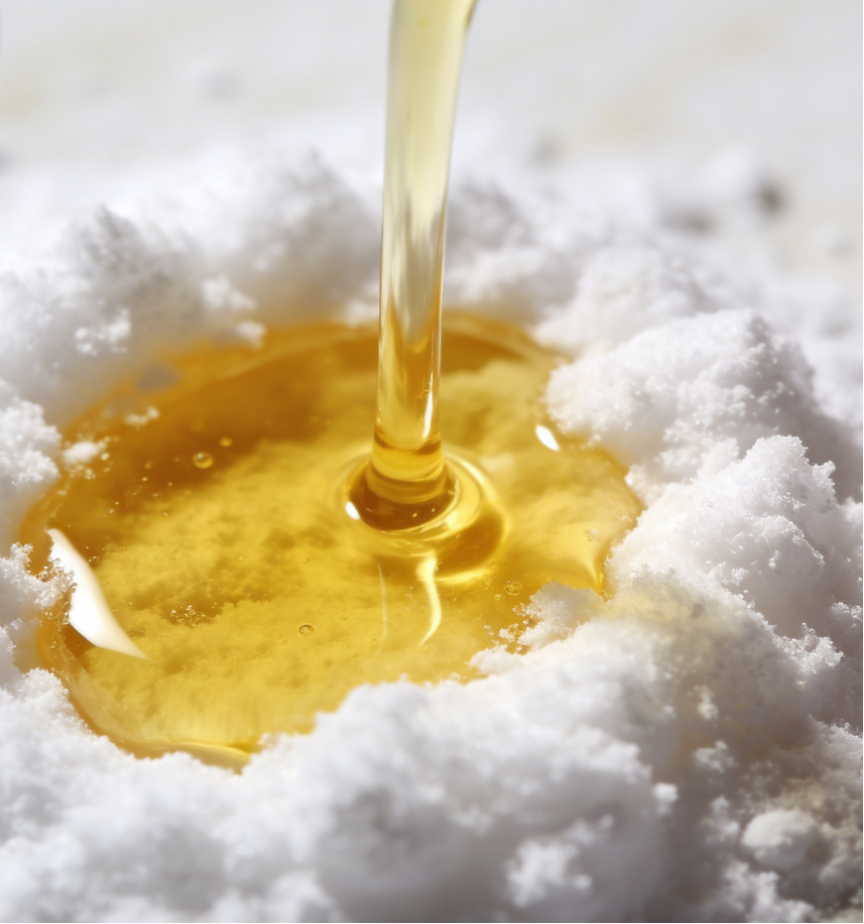
Fine powders tend to clump, cake, or turn sticky when exposed to damp air, and that behavior comes from what happens on the particle surface. When a powder is made up of dense, smooth grains, moisture settles between them and forms liquid bridges that pull the particles together. A porous structure changes this entirely. Instead of leaving water at the surface, the grain becomes filled with tiny channels, pockets, and capillaries that draw moisture inward. The powder no longer has to fight wetness on the outside; it stores the water inside its own internal volume, where it cannot glue particles to one another.
The size and shape of those pores matter more than total pore volume. Small pores fill first, even at relatively low humidity, while larger pores stay open until conditions become more saturated. This creates a staged response: the material picks up a little moisture early, then gradually takes on more as the air gets wetter. Because the uptake is spread across that range, the powder avoids the sudden saturation point that makes ordinary desiccants feel dry one moment and overwhelmed the next. It works more like a buffer, smoothing out swings in ambient moisture rather than simply reacting to them.
There is also a release side to the process. When the surrounding air dries out, moisture stored in the pore network can move back to the surface and evaporate. The same short internal paths that allowed water to enter now let it leave without trapping it permanently. That reversible exchange is what turns a fine powder from a passive material into an active moisture manager. Instead of degrading into lumps or losing flowability, the powder keeps its texture while quietly absorbing and releasing water as conditions shift.
Why Powders and Seasonings Stay Loose in Humid Kitchens
Most powdered seasonings stay loose because their particles are deliberately given uneven, almost craggy surfaces. Instead of flat planes that can pack tightly and trap moisture between them, the grains touch only at small points, leaving enough microscopic air gaps for a little humidity to move without turning the whole jar into a solid lump. Anti-caking powders such as silicon dioxide or calcium silicate add another layer of insurance by clinging to each particle and competing for the same water vapor that would otherwise create sticky bridges.
The formula itself also matters more than the weather outside. Many blends include maltodextrin, dried starches, or a small amount of oil or fat that coats hygroscopic ingredients like onion powder or garlic powder. These carriers absorb a bit of moisture slowly or repel it just enough to delay clumping. In a humid kitchen, that delay is often all a shaker needs, since the lid is opened for a few seconds at a time rather than left exposed for hours.
Packaging does the rest of the work. Tight-sealing caps, small desiccant packets tucked under the lid, and bottles designed with narrow openings reduce the amount of moist air that can enter during daily use. Rather than relying on one fix, the whole system—particle design, formulation, and container—keeps powders loose even when the air feels heavy.
Safe Daily Exposure and the Numbers Behind the Warnings
Most people glance at a warning label and see a single number—a milligram count, a percentage, a daily cap—without realizing how that figure survived years of animal studies, human trials, and statistical wrangling. The “safe” exposure level is rarely a clean threshold. It usually starts with a no-observed-adverse-effect level, or NOAEL, from rodent data, then gets divided by a safety factor of 10 or 100 to account for species differences and individual variability. So the number printed on a package isn’t a cliff edge; it’s more like a speed limit chosen to keep even the most sensitive drivers from crashing.
Take caffeine, for instance. Health agencies often cite 400 milligrams per day as a reasonable ceiling for most adults, but that figure assumes a 70-kilogram body, average metabolism, and no underlying heart issues. A pregnant person, a slow metabolizer, or someone on certain antidepressants might feel jittery, sleepless, or worse at half that dose. The warning on an energy drink doesn’t tell you your personal limit—it tells you a population-level average, rounded down to leave a buffer. Similarly, the “acceptable daily intake” for a food additive like aspartame is set at 40 milligrams per kilogram of body weight in Europe, which sounds precise until you realize it’s based on animal studies from the 1970s and then padded with a hundredfold uncertainty factor.
The real trouble is that these numbers are static, but bodies and habits are not. A daily exposure that’s harmless on its own can become problematic when stacked with other sources—lead in old paint plus lead in turmeric plus lead in tap water, or acetaminophen from a cold pill plus from a painkiller. Warnings rarely account for that cumulative load. They also can’t reflect how a person’s genetics, age, or gut microbiome shifts the dose-response curve. So the next time you read “safe daily exposure,” it’s worth asking: safe for whom, under what conditions, and with what margin? The number is a decent starting point, but it’s a lot softer than the decimal point suggests.
Reading Labels for Silicon Dioxide Without the Fear Factor
Seeing "silicon dioxide" on an ingredient list can feel like staring at a chemistry experiment, but the name hides a fairly ordinary job. It is used in tiny amounts to keep powdered foods and supplements from clumping, which is why it shows up in everything from seasoning blends to protein shakes. The compound is basically silica, a mineral that occurs naturally in water, plants, and even your body.
The fear usually comes from the word "dioxide" and the mental jump to sand or glass. Food-grade silicon dioxide is not the same as industrial silica dust; it is processed into an amorphous form that passes through the digestive tract without accumulating. Regulators in the US and Europe have reviewed it for decades and continue to allow it at low levels, which suggests the concern is more about the label than the ingredient.
A practical way to read the label is to pay attention to dose and context, not just the chemical name. If it appears near the end of the list in a powdered product, the amount is almost certainly minimal. For most people, the bigger issues on a label are things like added sugars or sodium, not a flow agent keeping the powder dry.
Choosing a Supplier When Every Vendor Calls Their Product Premium
When every supplier claims the same label, the word itself stops helping. I ignore “premium” and ask each vendor to describe one place where their product falls short of a competitor’s. The useful suppliers hesitate, then give a specific answer about a coating, a tolerance, or a lead time. The ones who insist there is no weakness are usually selling a brochure, not a material.
Next, I ask them to translate “premium” into numbers they actually control. If they cannot point to a measurable limit—like particle size, batch-to-batch viscosity, return rate, or dimensional drift—then the word is just packaging. A real definition shows up in a test report with a failing result on it, not in a perfect spec sheet.
Finally, I place a small paid order from regular production and ask them not to send a pre-approved sample. The invoice changes how carefully they pack, document, and communicate. Premium shows up in the dull details: the same carton labeling twice, a quick answer to a tolerance question, and a delivery that matches the quote without follow-up.
FAQ
It mainly keeps powders from clumping by trapping moisture instead of letting it bind particles together. That means spice blends stay free-flowing, protein powders don't turn into lumps, and instant drink mixes pour evenly from the scoop.
Yes. The packets contain desiccant beads that are not meant to be eaten. Food grade silica is a much finer, purified form that is approved for direct addition to foods and is used at very low levels to control moisture and caking.
By controlling moisture inside the package, it reduces the chance of powders absorbing humidity and degrading. This helps keep texture consistent and slows spoilage reactions that thrive in damp conditions, so the product stays usable longer.
When consumed within approved limits, it is generally well tolerated. It passes through the digestive system without being absorbed into the body in meaningful amounts. Most people don't notice any effects beyond ordinary consumption.
You'll often find it in dry seasoning mixes, powdered coffee creamers, grated cheese, protein shakes, vitamin powders, and pressed tablets. It helps these products pour, scoop, and mix more predictably.
Look for terms like silicon dioxide or E551 on the ingredient label. If it appears near the end of the list, that usually means it is being used in a small amount as an anti-caking agent or carrier.
At the levels used, it should be essentially invisible. It doesn't add flavor or alter color, and it won't create a gritty texture when it is properly dispersed in the product.
Only if you are using a grade explicitly labeled for food use. You would need to measure it very carefully because a tiny amount goes a long way, and mixing it evenly into a dry blend at home can be tricky. Most home cooks get better results by keeping blends dry and storing them with proper lids.
Conclusion
Food-grade certification is not a cosmetic change. It means the silica has been tested for heavy metals like lead and arsenic, and it meets stricter purity requirements than industrial grades. That distinction matters when the powder is added directly to products people eat daily. The physical benefit comes from the material's porous architecture: a single gram can carry a surprisingly large internal surface area, and those microscopic pores pull in moisture vapor before it condenses on surrounding particles. For powdered garlic, spice rubs, or instant drink mixes, this keeps the product loose and pourable instead of turning into a solid block during humid weather. The moisture is held in place rather than released as free water.
Many warnings about silicon dioxide come from inhalation studies or occupational dust exposure, not from the small quantities used in food. Safety assessments set daily intake limits that are much higher than typical consumption, and the compound is not absorbed in a way that builds up in tissues. When reading a label, seeing silicon dioxide can feel alarming, but it is simply a mineral already present in many plant foods and water. The real challenge is supplier selection. If every vendor claims a premium product, ask for third-party assay results, pore volume, and particle size consistency instead of relying on vague quality claims. That is where genuine food-grade silica stands apart from a commodity powder that only looks similar.
Contact Us
Contact Person: Levin Wang
Email: [email protected]
Tel/WhatsApp: 8618668999988
Website: https://www.silicaplant.com/