

Professional PTFE Guidewire Types and How to Choose the Right One
2026-10-02
Selecting the right PTFE guidewire can make or break a complex procedure, yet many interventionalists overlook the subtle differences between types. From the coating's durability to the core's flexibility, each specification matters more than you'd think. In this guide, we’ll break down professional PTFE guidewire types and the key factors to consider, so you can navigate the options with confidence. And when it comes to trusted performance, keep an eye on INT—a brand that’s quietly redefining precision.
PTFE Coating Thickness Changes Pushability More Than You Think
Most engineers treat PTFE coating as a binary choice: coated or uncoated. Yet thickness variations of just a few microns can shift how a guidewire or catheter moves through tortuous vasculature. A slightly thicker layer reduces surface friction but adds stiffness and increases outer diameter, which can make tight bends harder to navigate. Conversely, a thinner coat preserves flexibility but may expose substrate irregularities that catch on vessel walls.
The interplay between coating thickness and pushability is rarely linear. In bench tests, a 5-micron increase in PTFE can drop trackability by over 15% in moderate curves, while only improving lubricity by a marginal amount. This means the optimal coating thickness depends on the specific anatomy: smaller distal vessels often demand thinner coats for better tip response, while proximal segments tolerate thicker coats for enhanced durability during repeated passes.
Manufacturers often overlook this nuance because standard validation protocols use straight or gently curved models. Real-world performance diverges sharply when devices face multiple 180-degree turns. Adjusting PTFE thickness by even 2–3 microns can change the feel in a clinician's hand more than switching base materials, making it a hidden lever for fine-tuning device performance.
Angled Tips Are Not Always Better for Bifurcation Crossings
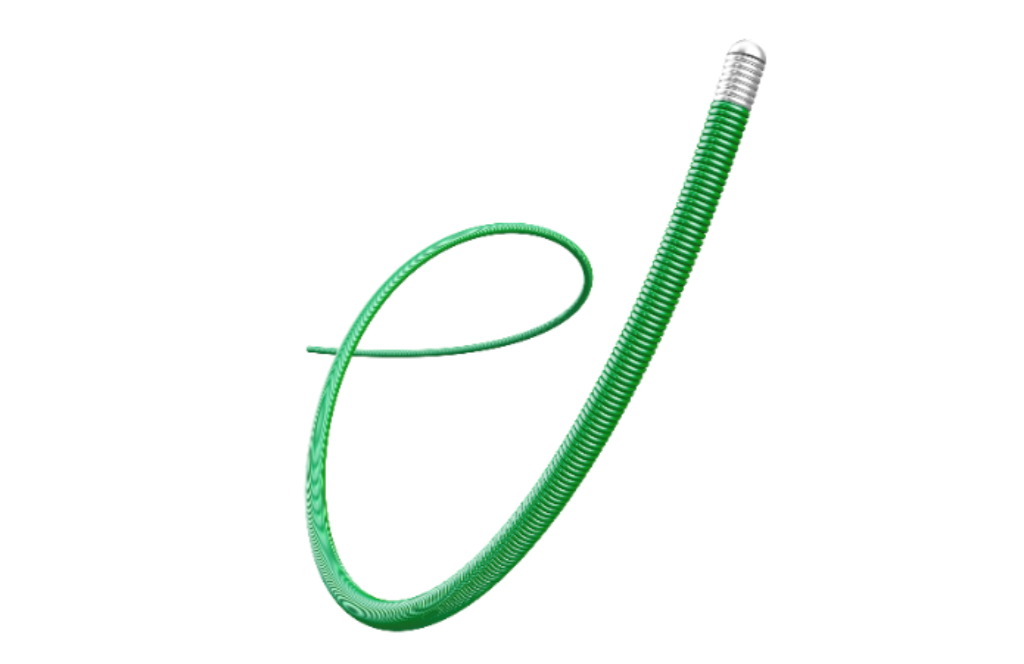
Many operators assume a sharply angled wire tip will automatically slip into a side branch when crossing a bifurcation, but that assumption falls apart in tighter angles or heavily diseased segments. An aggressive bend can actually force the tip against the plaque shoulder or the carina, creating resistance rather than smooth entry. The wire may prolapse into the main vessel or scrape along the vessel wall, raising the risk of dissection.
A modest curve, or even a straight tip with careful rotation, often tracks more predictably through the bifurcation because it follows the natural flow lumen instead of fighting it. This is especially true when the side branch arises at a shallow angle or when there is significant calcification near the ostium. In those settings, a softer, less angled wire slips past the carina with less trauma and allows for gentler guidewire exchanges if needed.
The real skill lies in matching the wire shape to the specific anatomy rather than defaulting to a steep angle. Spending an extra minute shaping a gentle secondary curve or testing a workhorse wire with a barely visible tip bend can save time and reduce complications, since the crossing itself should not become a contest of force.
Diameter Mismatch Causes Most of the Frustration in Small Vessels
Frustration in small vessel procedures rarely stems from a lack of skill—it comes from the quiet mismatch between what you expect and what the anatomy actually gives you. A catheter that slides easily through a larger artery can become a struggle in a vessel just half a millimeter narrower. The diameter you planned for on the screen doesn't always translate to the tactile reality: walls that grip too tightly, guidewires that catch on every curve, and contrast that pools instead of flowing. This mismatch isn't a single event; it's a cumulative drag that turns a routine case into a test of patience.
Most operators don't realize how much of that frustration is driven by diameter alone, not by complexity of the lesion or calcification. A 0.5 mm difference in vessel caliber can force you to downsize your balloon, exchange your wire, or abandon a device that worked perfectly in your last case. The result is wasted time, multiple exchanges, and a growing sense that the vessel is fighting you—when in reality, the tools are simply too big for the space they're in. Recognizing this early changes the approach: measure twice, choose the smaller device first, and accept that small vessels demand a different rhythm.
What separates experienced operators from those still learning isn't just technique—it's the willingness to adapt to the vessel's true diameter without forcing the plan. When you stop fighting the mismatch and start working with it, the frustration fades. The vessel becomes less of an obstacle and more of a guide, telling you exactly what size it needs. That shift in perspective turns a frustrating small vessel case into a straightforward one, not because the anatomy changed, but because you finally listened to what it was saying all along.
The Core Wire Under the PTFE Decides How Much Torque You Get
It is easy to assume the PTFE outer layer controls rotational response, but that layer mainly reduces friction so the core can spin without grabbing. The actual torque transfer comes from the core wire: its alloy, diameter, and whether it is solid, stranded, or braided. A heavier stainless core gives a crisp, nearly one-to-one feel at the handle, while a thinner or more elastic core absorbs some twist before the distal end starts moving.
Tapering and cross-section changes along that core are where torque gets wonky. An abrupt step down in diameter acts like a flex point, converting some of your rotation into a sudden whip or lag. A gradual taper spreads the torsional load more evenly and keeps the input and output ends in sync. Before blaming the coating for poor response, compare the core wire construction underneath the PTFE.
Working Length Matters More Than Total Length in Tortuous Paths
In a tortuous path, the total length measured along every bend and curve can be misleading. What actually controls how deep an instrument or measurement device can safely reach is the working length—the straight-line distance from a fixed reference point to the intended endpoint. This is especially true in curved root canals, where the canal may curve sharply; the true path length can exceed the working length by several millimeters, but those extra millimeters do not correspond to additional usable depth.
Total length also lacks repeatability in a curved space. The same canal imaged from two different angles can produce different apparent lengths, while a working length tied to a stable coronal landmark and the apical constriction remains consistent. Relying on total length in a tortuous path invites over-instrumentation: the instrument may be advanced too far, leading to ledging, transportation, or even perforation of the outer curve. Working length, by contrast, gives a safe and reproducible endpoint that respects the actual geometry.
Small errors become magnified in tortuous paths because curvature already reduces tactile feedback and concentrates stress at the point of maximum flexure. In such settings, verifying the working length is more important than knowing the full curvilinear distance. A carefully confirmed working length allows controlled negotiation of the curve, whereas an incorrect total length estimate often ends in procedural failure. For anyone working inside curved or twisted conduits, the practical rule is clear: the working length is the primary measurement to track, while total length is secondary at best.
Hydrophilic Coatings Beat PTFE Only in Specific Lesion Types
Clinical experience shows the advantage of hydrophilic coatings is far from universal. In straight, non-calcified vessels, PTFE already provides enough lubricity for smooth navigation, and the extra water-activated slipperiness of a hydrophilic surface doesn't translate into higher success rates. But when you move into heavily tortuous, acutely angled, or densely calcified segments, that coating earns its keep. The hydrated layer dramatically cuts friction between the device and the vessel wall, letting you cross spots where a PTFE surface would bind up or demand repeated reshaping.
A widespread assumption is that hydrophilic coatings outperform PTFE in every interventional scenario. The reality is more nuanced. In certain lesion subsets—like the proximal cap of a chronic total occlusion or an extremely tight, calcified stenosis—a hydrophilic wire can find and follow microchannels that a PTFE-coated wire simply cannot engage due to higher surface drag. Yet in short, uncomplicated lesions, the two surfaces deliver statistically similar results. Some operators even prefer PTFE in those cases because it preserves more tactile feedback, which can be useful when you want to feel subtle changes in resistance.
Coating selection should follow lesion anatomy rather than habit. If you are dealing with long, diffuse, heavily calcified disease or a particularly tortuous course, the real value of a hydrophilic coating becomes obvious. For everything else, sticking with PTFE may be more economical without sacrificing performance.
FAQ
PTFE guidewires add a low-friction fluoropolymer layer that reduces drag inside catheters and tortuous vessels. That coating also gives a predictable tactile feel, which helps when you need steady advancement without the sudden slip common with hydrophilic wires.
Straight, angled, and J-tip options cover most needs. Straight tips suit direct vessel entry, angled tips help select side branches, and J-tips reduce the risk of vessel trauma or subintimal passage when advancing through curved anatomy.
Because PTFE lowers surface friction, more of your rotational input reaches the distal tip instead of being lost to binding. That translates to crisp torque control, while the underlying core design still determines how much push force the wire can transmit without buckling.
Coronary cases typically use 0.014-inch wires from 180 to 300 cm, while peripheral interventions often move up to 0.018 or 0.035 inches and lengths over 260 cm for exchange purposes. Always match the wire to the smallest device lumen and the distance from access point to target.
Go stiffer when you need to support balloon or stent delivery across calcified or highly tortuous segments. A more flexible wire serves diagnostic runs or crossing delicate, tight lesions where preserving vessel integrity matters more than support.
PTFE wires offer more controlled advancement, which can reduce the chance of accidental vessel perforation in fragile anatomy. Hydrophilic wires may glide through tight stenoses more easily, but that same slipperiness can make them less predictable, so many operators reserve PTFE for cases where tactile feedback is critical.
Wipe the wire with a sterile saline-soaked gauze rather than dry gauze to avoid scratching the coating. Avoid sharp bends or kinks near the tip, and store it in its hoop or dispenser when not in use. Inspect for coating delamination before reintroducing into a patient.
They work with most standard diagnostic and interventional catheters, but check the inner lumen diameter and coating compatibility. PTFE's low friction generally aids passage through polyurethane and polyethylene catheters, though very tight microcatheter clearances may still require a smaller wire profile.
Conclusion
Choosing a Professional PTFE guidewire involves far more than comparing diameters and tip shapes. Many operators overlook how significantly the coating thickness alters pushability; a thicker PTFE layer feels smooth but can blunt tactile feedback and make crossing tight lesions more difficult. Angled tips are often assumed to be superior for bifurcation crossings, yet in practice a straight or gently curved tip tracks more predictably because it does not snag on the carina or deflect unexpectedly. In small vessels, diameter mismatch—not the nominal wire size alone—accounts for most of the frustration: a distal segment that is too stiff or too large for the lumen will refuse to advance smoothly, no matter how carefully you torque it.
The core wire hidden beneath the PTFE jacket decides how much torque you actually get. A stiffer core improves rotational control but gives up flexibility; a tapered or nitinol core balances the two more effectively. Working length matters more than total length in tortuous paths; even a 180 cm wire with a short floppy section can be too rigid through tight curves, while a longer flexible segment on a shorter overall wire often handles better. Finally, hydrophilic coatings beat PTFE only in specific lesion types—typically heavily calcified or extremely tight stenoses where minimal friction is essential. In most other anatomies, PTFE remains more durable, predictable, and resistant to damage during multiple exchanges, which is why it still holds a central place in everyday practice.
Contact Us
Contact Person: Jeffrey
Email: [email protected]
Tel/WhatsApp: 86-0633-2230056
Website: https://www.sd-intmedical.com