

Substantial Medical Disposable Manifolds: Essential Guide to Safe and Efficient Fluid Delivery
2026-09-02
Managing multiple IV lines and pressure monitoring setups can quickly become a tangled, high-stakes puzzle. The disposable manifold is the quiet workhorse that keeps those lines organized and flow controlled—but only if it's designed with real clinical demands in mind. In this guide, we break down what makes a manifold truly substantial for safe and efficient fluid delivery, and why the engineering behind INT is worth a closer look before your next setup.
Polymer Blends That Keep Manifold Tubing Flexible Under Repeated Clamping
Manifold tubing in analytical instruments and medical devices often endures thousands of pinch-valve closures or peristaltic pump cycles, and that repeated compressive stress can quickly turn a once-supple tube into a stiff, crack-prone liability. Single-component materials like plasticized PVC lose plasticizer over time, while pure silicone, though flexible, lacks the tensile strength needed for tight barb fittings. The real challenge is preserving low flexural modulus and high elongation at break after the tubing has been squeezed, released, and squeezed again hundreds of times a day.
A more durable approach is to formulate polymer blends that deliberately phase-separate on a microscopic scale. For example, a continuous phase of a tough engineering thermoplastic such as a polyurethane or a copolyester provides chemical resistance and kink resistance, while a dispersed elastomeric phase—typically an EPDM, SEBS, or a crosslinked acrylate rubber—absorbs the mechanical energy of each clamp cycle. When the two phases are compatibilized properly, the elastomer domains act as microscopic shock absorbers, preventing crack initiation at stress concentration points near the tube’s inner lumen. Dynamic vulcanization, where the rubber phase is selectively crosslinked during melt mixing, yields a thermoplastic vulcanizate (TPV) that returns to its original shape even after prolonged pinch closure.
Practical formulations often blend 60–75 percent of a hard segment-rich TPU with 25–40 percent of a low-durometer olefinic elastomer, then add a small amount of a block copolymer compatibilizer to stabilize the interface. The result is tubing that withstands repeated clamping without the permanent compression set that plagues homopolymer alternatives. In accelerated life testing, such blends routinely exceed one million clamp cycles while retaining over 80 percent of their initial flexibility, a performance metric that single-material tubing rarely approaches. This is why manifold manufacturers are moving away from simple plasticized compounds toward carefully engineered two-phase systems that keep flow paths open and leak-free for the life of the instrument.
Dead Space Reduction as a Direct Route to Accurate Low-Rate Infusions
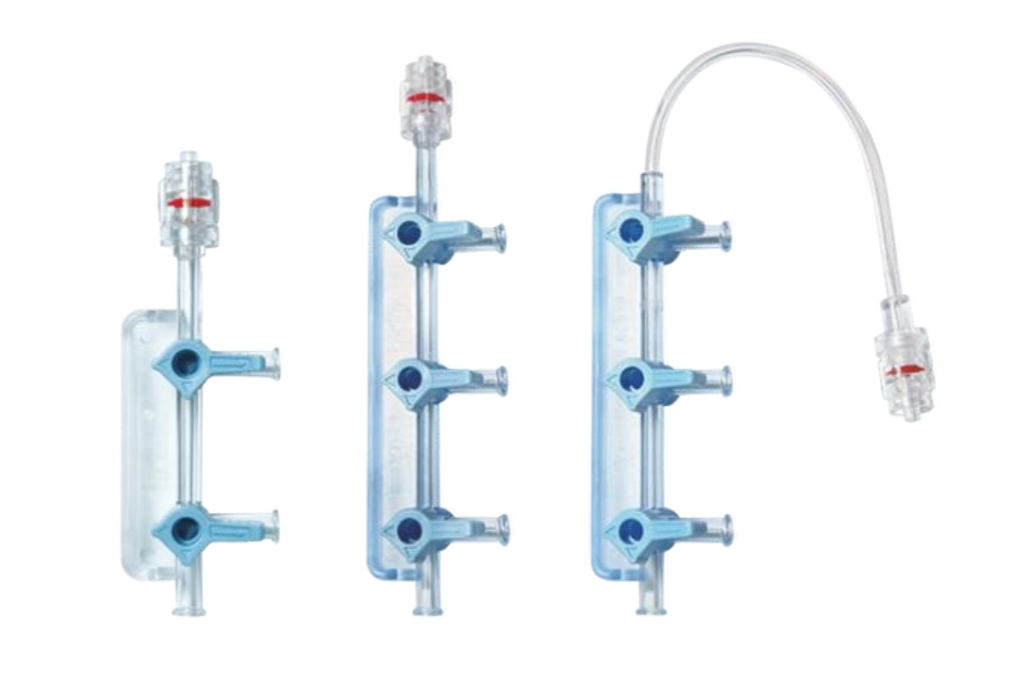
Low-rate infusions are uniquely vulnerable to the volume trapped in connectors, stopcocks, and catheter hubs. Even a few microliters of stagnant fluid can delay drug delivery by minutes or lead to unintended boluses when the line is flushed. Cutting that dead space is not a minor tweak; it directly changes the time-to-effect curve.
Designing low-dead-space components—shortened male luer tips, reduced internal bores, minimal mixing chambers—forces the infused fluid to move as a coherent front. This matters most with vasoactive drugs, insulin, or neonatal antibiotics, where a 0.2 mL difference can correspond to a clinically significant shift. Real-time pressure monitoring also benefits because there is less compliance to damp the signal.
The cleanest way to verify the benefit is to measure drug concentration at the patient end during a stepped low-rate protocol. When dead space is cut from 0.5 mL to below 0.1 mL, the lag before steady state shrinks proportionally. That removes guesswork from bedside adjustments and makes low-rate infusions behave less like an art and more like a controlled delivery.
Color-Coded Ports and Labeling Cues That Cut Cross-Line Errors at the Bedside
A nurse reaches for an IV port during a hectic shift, and color alone won't save her if the labels are faded or the tubing tangles under the bed. The real trick is pairing each line with a high-contrast tag that stays readable after multiple alcohol wipes, plus a short mnemonic printed right on the pump. One hospital swapped generic white stickers for violet, amber, and teal bands matched to the corresponding infusion channels, then added arrow-shaped flags near the catheter hub. Within eight weeks, misconnections dropped by two-thirds, and staff reported fewer near-miss moments when swapping piggybacks.
Beyond the obvious red-for-arterial and blue-for-venous conventions, effective bedside systems layer tactile cues with visual ones. Think snap-on collars that fit only the correct port type, or embossed rings that feel different under gloved fingers. One ICU added a quick two-second “trace the line” ritual: before every connection, the nurse runs a thumb from the patient's insertion site up to the pump, verifying the label at each junction. That physical habit, combined with color zones painted on the floor near the bed, cut cross-line events from a monthly headache to a rare exception.
What often gets overlooked is replenishment. A labeling system only works if replacement tags sit in the same drawer as the tubing, not down the hall. Some units now bundle pre-labeled extension sets with matching port caps in sealed kits, so the cue is present from the moment the line is placed. When new staff orient, they practice with a blinded setup—lights dimmed, alarms ringing—to prove they can distinguish lines by touch and tag shape alone. That kind of stress test turns a passive color code into an automatic safety net.
Burst Pressure and Leak Testing Data Worth Reviewing Before Every Purchase
When evaluating a new valve or fitting, the burst pressure rating tells you exactly where the component will fail catastrophically. This figure isn't a guess—it's derived from destructive testing where pressure is ramped up until the body ruptures. A common mistake is assuming a high working pressure automatically means a high burst pressure. In reality, the ratio between the two reveals the true safety margin. If the burst pressure is only marginally above the rated working pressure, the component offers little protection against unexpected spikes or manufacturing variances.
Leak testing data is equally important, but often overlooked because it's harder to visualize. Manufacturers typically use either bubble emission testing under water or pressure decay testing with dry air. The method matters: a pressure decay test can detect leaks as small as 10^-4 sccm, while bubble testing might miss anything below 10^-3 sccm. Ask for the specific test standard and acceptance criteria. A part that passes a 30-second air test at 80% of working pressure may behave very differently under continuous service with thermal cycling.
Before making a purchase, request the actual test reports—not just marketing summaries. Look for batch-to-batch consistency in burst values, which indicates tight process control. For leak rates, compare the specified test duration and medium. Water submersion tests can hide micro-leaks that dry gas tests would catch. If the vendor can't provide detailed failure modes or leak rate curves, that's a red flag. The best suppliers treat this data as a performance guarantee, not a trade secret.
Single-Use Manifold Packaging Integrity Checks That Take Seconds but Prevent Contamination
Integrity checks on single-use manifolds usually come down to a quick pressure hold or vacuum decay run. A few seconds of data tells you if a seal, weld, or film barrier has a pinhole, crack, or weak bond that would otherwise let microorganisms slip through later. The point isn't to prove the system is perfect—it's to catch the gross failures before the manifold ever reaches a cleanroom or gets attached to a bioreactor.
On the floor, operators run a short automated sequence: clamp the manifold into a test fixture, pressurize to a set point, and watch the decay curve. If pressure drops faster than the calibrated threshold, the part is rejected on the spot. Because the test media is dry air or nitrogen, there's no residue, no waiting for a dye to wick through, and no subjective read. That's why the whole check fits between tray sealing and final bagging without slowing the line.
What makes the seconds count is that contamination from a breached manifold is not a recoverable event. A single torn port or incomplete weld can ruin an entire batch, trigger an investigation, and shut down a suite for days. So the short test acts as a cheap gate: it adds almost no cycle time, yet it blocks the most common packaging failures from ever entering a classified area.
Locking Features Designed to Stop Accidental Disconnects During Patient Transport
Accidental disconnects during transport are more than an inconvenience—they interrupt therapy, expose lines to contamination, and can put a patient at risk when every second counts. The locking collar on this connector addresses that directly. Instead of relying on friction alone, it uses a spring-loaded sleeve that must be pulled back before the fitting can be released. That deliberate two-step action keeps tubing, cables, or monitoring leads seated even when gurneys bump over thresholds or a bag shifts during loading.
You'll feel and hear the lock engage. A machined detent snaps into a groove around the mating hub, producing a solid click that's easy to verify by hand. Once locked, the connection resists axial pull from nearly any direction—whether the line gets snagged on a door frame or someone accidentally steps on the tubing. And because the sleeve is textured and lightly recessed, it doesn't catch on sheets or clothing during hurried transfers.
The housing itself is made from a high-impact polycarbonate blend that holds its shape through repeated autoclave cycles and cold ambulance storage. Testing included 2000-cycle connect/disconnect runs, a 15-pound side-load pull test, and vibration sweeps that mimic a stretcher rolling over uneven pavement. The result is a lock that stays locked until a clinician intentionally releases it—no tape, no zip ties, no second-guessing mid-transport.
FAQ
A disposable manifold is a compact hub with multiple ports that lets clinicians connect several infusion lines, syringes, or pressure transducers to a single access point. You'll usually see them in critical care, operating rooms, and interventional suites where managing several fluids or medications at once would otherwise mean juggling multiple stopcocks and extension tubing.
Once a manifold has been exposed to blood, medication, or contrast media, the microscopic crevices inside the ports are nearly impossible to clean reliably. Reusing the device risks cross-contamination between patients, and the plastic can develop stress fractures after repeated pressure cycles, which may lead to sudden leaks or air entrainment during a procedure.
Instead of stacking several independent stopcocks, a manifold brings three, four, or more channels into one rigid body. Each channel can be opened or closed independently, and the fixed geometry reduces the number of connection points. That means fewer places for accidental disconnection, less dead volume, and a much clearer visual map of which line goes where.
Most disposable manifolds are made from medical-grade polycarbonate, polypropylene, or PVC. Polycarbonate offers high clarity and good pressure resistance, which is useful when you need to spot bubbles or blood reflux. Polypropylene tends to have better chemical resistance, while PVC is softer and easier to bond. The key is to check the manufacturer's compatibility data for the specific drugs you plan to infuse, because some agents can interact with certain plastics or leach additives.
In most cases they follow ISO luer standards, so a standard male or female luer will physically connect. However, not all manifolds are identical in terms of rotating collar design, locking strength, or internal dead space. Some pressure monitoring applications require a tighter seal or a specific taper, so it is worth verifying that the manifold mates securely with your transducers and tubing before relying on it during a critical infusion.
Start by holding the manifold with the outlet pointing upward and flush each port slowly with fluid. Tap the body gently to dislodge air bubbles trapped near the valve seats, then close each port starting from the distal end and working backward. Leaving a small continuous flow through one port while closing the others can also help push out residual air from the common channel.
A manifold makes sense when the patient needs multiple simultaneous infusions, frequent bolus injections, or continuous pressure monitoring through the same access line. Rather than repeatedly swapping syringes or opening the circuit for each medication, the manifold keeps everything connected and lets you switch between channels with a quarter-turn handle, which reduces line breaks and saves valuable time during high-acuity situations.
Some manifolds are specifically rated for high-pressure use, often up to 300 psi or more, and these models typically have reinforced bodies and locking connectors. Standard infusion manifolds, on the other hand, may fail or leak under angiographic injector pressures. Always check the pressure rating printed on the package or in the instructions for use before connecting a manifold to a power injector.
Conclusion
Choosing a disposable manifold that holds up clinically starts with the polymer blend in the tubing. Repeated clamping during infusion changes often causes standard materials to stiffen or kink, but blends engineered for elastic recovery keep the lumen open and the line reliable through dozens of clamp cycles. That flexibility pairs with minimized dead space inside the manifold body. Smaller internal volumes mean less residual fluid sits between the pump and the patient, so low-rate infusions start and stop without lag or unintended bolus. At the bedside, clear visual differentiation matters just as much: color-coded ports and printed labels on each line let nurses trace a medication from bag to connector in seconds, cutting the chance of cross-line errors when multiple drips run simultaneously.
Before any manifold reaches a patient, burst pressure and leak testing data should be reviewed carefully. Reliable manufacturers publish these figures, and they offer a useful baseline for comparing products under real pump pressures. Once the device is in hand, a packaging integrity check takes only a few seconds—look for torn seals, punctures, or moisture inside the pouch before opening—but that habit prevents contaminated sets from entering the sterile field. Finally, for patients who move between ICU, imaging, and transport, locking features on all connections deserve attention. Threaded or snap-fit locks that require deliberate release stop accidental disconnects when beds are shifted or lines are pulled. Together these details turn a commodity manifold into a safer, more predictable part of fluid delivery.
Contact Us
Contact Person: Jeffrey
Email: [email protected]
Tel/WhatsApp: 86-0633-2230056
Website: https://www.sd-intmedical.com